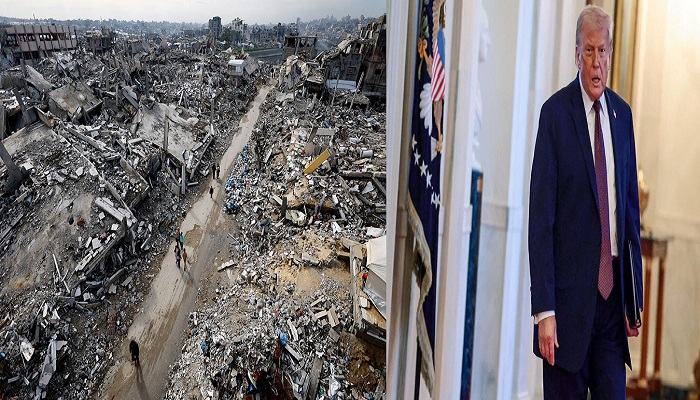
President Donald Trump unveils a 15-member Palestinian technocratic committee under his new Board of Peace, with international support from Indonesia, South Africa and Bangladesh, critics warn Palestinian voices risk being sidelined amid ongoing violence and aid shortages.
President Donald Trump announced the formation of The Board of Peace on his Truth Social platform, calling it “the greatest and most prestigious Board ever assembled.” He said members would be announced “shortly” and that a 15-member Palestinian technocratic committee would oversee Gaza’s day-to-day governance under the board’s supervision, which he will chair.
The plan also calls for an International Stabilisation Force to secure Gaza and train vetted Palestinian police units.
The Board’s Executive Board includes Marco Rubio (U.S. Secretary of State), Steve Witkoff (U.S. envoy), Jared Kushner (U.S. senior advisor, son-in-law of Trump and Jewish), Sir Tony Blair (former UK prime minister), Marc Rowan (investor), Ajay Banga (World Bank President), and Robert Gabriel.
Nickolay Mladenov was appointed High Representative for Gaza, and Major General Jasper Jeffers will lead the international force. A broader Gaza Executive Board includes Turkey’s Hakan Fidan, UAE’s Reem Al-Hashimy, Netherlands’ Sigrid Kaag, Qatar’s Ali Al-Thawadi, Egypt’s Hassan Rashad, and Israeli businessman Yakir Gabay.
Indonesia, the world’s most populous Muslim country, has trained up to 20,000 personnel for a possible Gaza peacekeeping and support mission focused on health and infrastructure. Discussions are ongoing about a multinational stabilization force coordinated with the U.S. South Africa has admitted a limited group of Palestinian refugees on humanitarian grounds, while Bangladesh has offered support through participation in the peacekeeping mission rather than hosting large numbers.
Pakistan has stated it may consider joining a multinational stabilization force under clear terms agreed with Muslim nations but has not committed to hosting refugees or disarming Palestinian groups like Hamas.
Several other countries including Ethiopia, Libya, and Somaliland/Somalia have been approached about hosting Palestinians but have not made formal commitments. Egypt has firmly rejected hosting large numbers outside Gaza, citing concerns that displacement could undermine Palestinian rights, a position echoed by Jordan and other neighboring states.
Most Arab and Muslim-majority nations, including Saudi Arabia, Qatar, and the UAE, support humanitarian aid, reconstruction, and political solutions within Gaza but oppose large-scale relocation. They argue that resettlement could normalize displacement and weaken Palestinian claims, favoring ceasefire enforcement, aid access, and governance within Gaza itself.
Putin Warns of Strong Response to Europe’s Militarisation
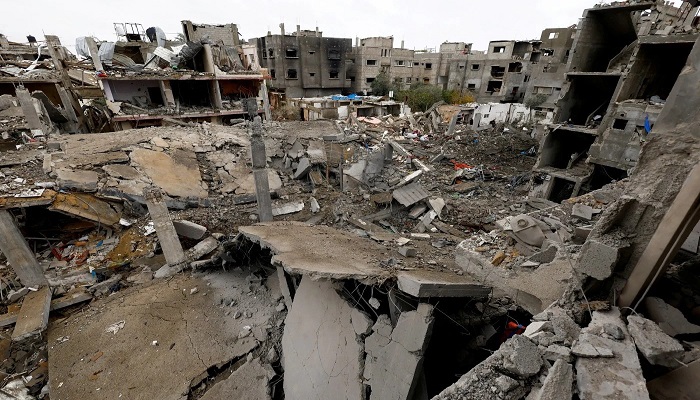
Critics warn that the U.S. plan risks sidelining Palestinian voices and resembles externally directed governance. Hamas’s Bassem Naim said the “ball is now in the court of mediators, the American guarantor and the international community to empower the committee,” amid ongoing aid shortages and violence.
Gaza’s Palestinian Ministry of Health reports that since October 7, 2023, over 68,000 Palestinians have been killed and 170,000 wounded, highlighting the severe human toll.
Reconstruction funding for Gaza is expected to come from a mix of international donors, multilateral institutions such as the World Bank, UN agencies, and regional financial bodies, with private investment supplementing public contributions. Initial operational budgets have been secured for the first year, while long-term rebuilding estimated at over $50 billion will require multilateral coordination, humanitarian contributions, and Palestinian-led management to ensure transparency and accountability.