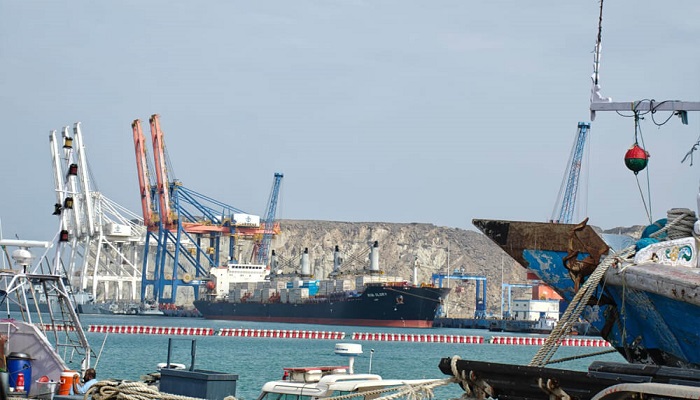
Pakistan’s deep-sea port is attracting new cargo, transit routes and marine services as regional shipping disruptions push traders to diversify. The momentum offers Gwadar a fresh opportunity to emerge as a regional logistics and investment hub at the heart of CPEC 2.0.
Pakistan’s Gwadar port is gaining fresh commercial momentum as disruption around the Strait of Hormuz encourages traders and shipping companies to explore alternative routes, giving Islamabad a timely opportunity to accelerate the next phase of its flagship economic partnership with China.
The deep-sea port on Pakistan’s southwestern coast has handled about 200,000 tonnes of transit breakbulk cargo over the past three months, according to Yu Bo, chairman of China Overseas Ports Holding Company, which operates Gwadar.
Container traffic has also risen sharply. Gwadar handled around 11,000 containers in April, exceeding the roughly 8,300 containers recorded during the whole of 2025, according to regional logistics data.
The increase comes as conflict involving the United States, Israel and Iran has disrupted shipping through the Strait of Hormuz, one of the world’s most important maritime chokepoints.
For Pakistan, the disruption highlights one of Gwadar’s strategic advantages, its location outside the Strait and its potential to connect China, Pakistan, Iran, Central Asia and Middle Eastern markets through a diversified network of land and sea routes.
“Gwadar is no longer simply a port under development. It is increasingly becoming a platform for regional connectivity,” said analysts familiar with Pakistan’s logistics sector.
The opportunity fits closely with the ambitions of CPEC 2.0, the second phase of the China-Pakistan Economic Corridor, which is expected to shift the focus from large infrastructure projects towards trade, industrial cooperation, investment, technology, agriculture and employment.
CPEC was launched more than a decade ago as a flagship component of China’s Belt and Road Initiative, bringing major investment into Pakistan’s energy, transport and port infrastructure.
Gwadar became the maritime centrepiece of that strategy. The next challenge is to convert infrastructure into sustained commercial activity. Recent developments suggest that transition is beginning.
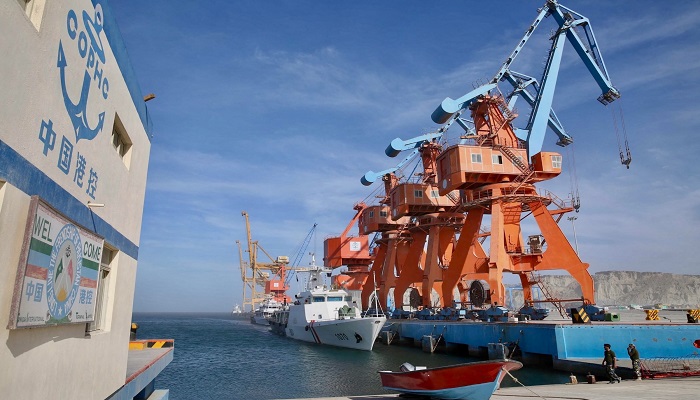
Pakistan’s Ministry of Commerce introduced six transit routes in April for third-country cargo moving through Pakistan towards Iran and Central Asia. One of the most important is the roughly 87-km Gwadar-Gabd route, linking the port with Pakistan’s border with Iran.
The shorter connection could offer some Iran-bound cargo an alternative to established routes from Karachi, while strengthening Gwadar’s position as a gateway for regional transit trade.
The port is also expanding beyond traditional loading and unloading operations.
Pakistan recently completed its second marine-bunkering operation at Gwadar after launching the service in July. The operation involved supplying internationally compliant very-low-sulphur fuel oil to an LNG carrier by bunker barge.
The fuel was supplied by global energy trader Vitol and produced by Pakistan’s Cnergyico refinery.
Bunkering gives Gwadar an additional source of port revenue while creating another reason for international vessels to call at the port.
Pakistan now offers marine bunkering at its three major commercial ports — Karachi, Port Qasim and Gwadar — strengthening the country’s broader maritime-services ecosystem.
The significance of Gwadar’s recent activity goes beyond the immediate increase in cargo.
For potential investors, the port offers the foundation of a wider logistics and industrial cluster: a deep-sea port, free-zone facilities, road connections, a new international airport and technical training infrastructure.
The government’s objective is to attract manufacturers, logistics companies, exporters, energy businesses and technology firms that can use Gwadar as part of regional supply chains.
That could give CPEC 2.0 a more commercially driven character.
Rather than measuring the corridor only by kilometres of roads or megawatts of electricity capacity, the next phase can be judged by the volume of goods moving through Pakistan, factories established along the corridor, investment attracted into special economic zones and jobs created for local communities.
Gwadar could play a central role in that transformation.
Pakistan is also examining ways to expand the port’s role in energy logistics. The Gwadar Port Authority has indicated that plans for an Oil City in the district are being reconsidered, potentially creating opportunities for storage, refining and petroleum-related processing.
Such projects would require significant capital and supporting infrastructure, but they could add another layer to Gwadar’s emerging commercial ecosystem.
The opportunity is to become an additional gateway for regional trade and a diversification option for companies seeking greater resilience in their supply chains.
The disruption around Hormuz has demonstrated the economic value of alternative maritime and overland routes.
If Pakistan can retain some of the cargo attracted by the current crisis, expand port services and build reliable connections into Central Asia, western China and regional markets, Gwadar could emerge with a stronger long-term commercial role.
Pakistan is strengthening the supporting ecosystem around Gwadar to ensure the port can fully capitalize on its strategic location. Reliable utilities, streamlined customs procedures, competitive port services, digital logistics systems, security and a predictable regulatory environment are creating the conditions needed to attract shipping lines, logistics operators and long-term investors.
These improvements can help turn the current rise in activity into a broader investment cycle, supporting new industries, regional trade and high-value maritime services as Gwadar advances into the next phase of its development under CPEC 2.0.
A successful Gwadar model will therefore need to combine international trade with local economic participation.
More port activity can create opportunities in logistics, marine services, construction, hospitality, fisheries, processing, transportation and technical employment — provided local communities have access to those opportunities.
For CPEC 2.0, that could become one of the most important tests of the project’s next chapter.
Gwadar’s commercial transformation has been discussed for years, but the current disruption in regional shipping has created a new sense of urgency.
The rise in cargo, the introduction of new transit corridors and the launch of marine-fuel services indicate that the port is beginning to develop the characteristics of a functioning regional maritime hub rather than remaining primarily an infrastructure project.
The immediate opportunity is to use that momentum to attract shipping lines, logistics operators, manufacturers, energy companies and other private investors.
For China, Gwadar provides another potential link between western China and international markets. For Pakistan, it offers a chance to turn strategic geography into trade, investment and employment.
The disruption around Hormuz may eventually ease, but the lesson for global supply chains could endure, companies increasingly value alternative routes and diversified gateways. That gives Gwadar an opening.
The real measure of CPEC 2.0 will be whether Pakistan can turn that opening into sustained commercial activity and whether Gwadar can evolve into a competitive regional hub that delivers lasting economic value for Pakistan, China and the people of Balochistan.